
What Are Industrial Staple Pins and Why Do They Matter in Packaging?
Defining the Product: More Than a Simple Fastener
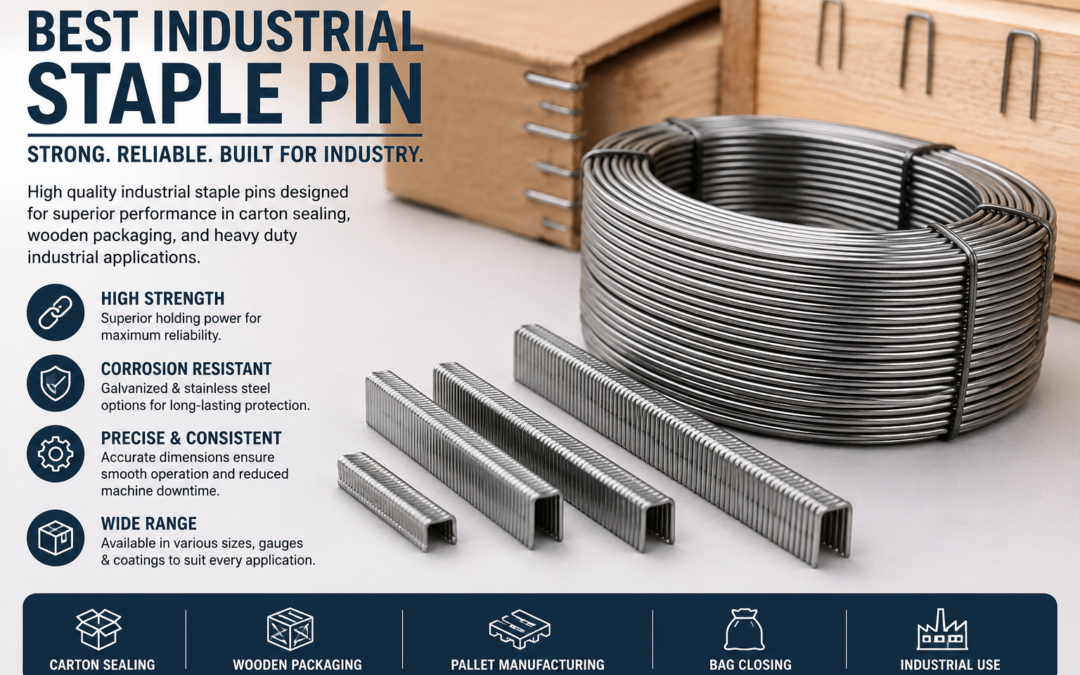
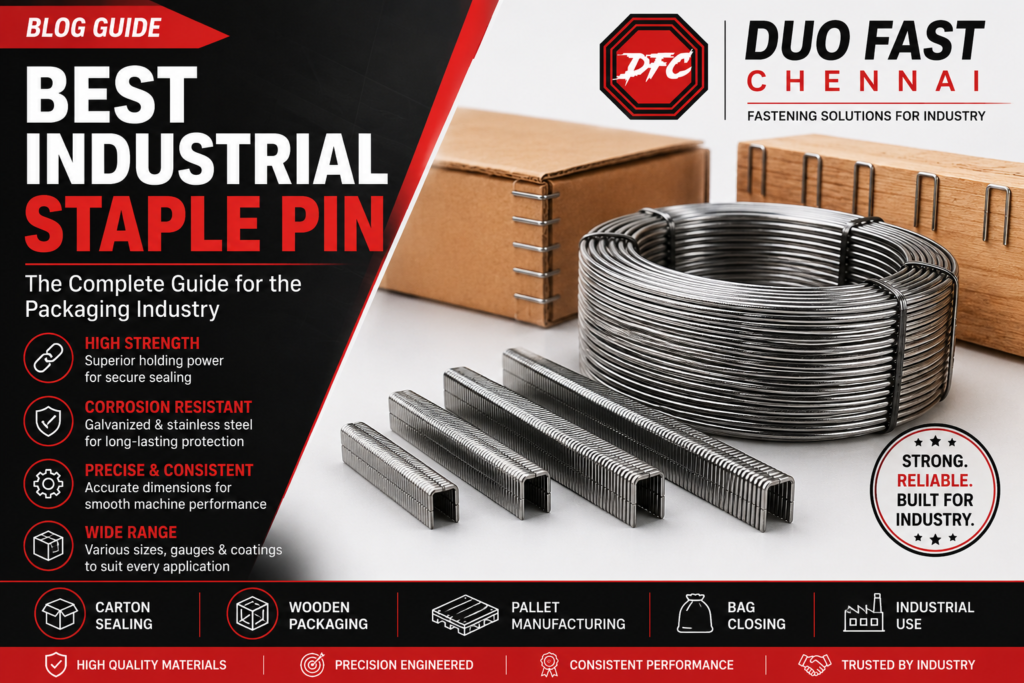
The term ” best industrial staple pin” covers a broad family of metal fasteners used across manufacturing, construction, agriculture, and — most heavily — the packaging industry. At their most basic, these are U-shaped wire fasteners that are driven through one or more layers of packaging material by a stitching machine, staple gun, or carton closing head, with the legs folding back on the underside to create a clinched, locked joint.
What separates the best industrial staple pins from generic hardware-store staples is the engineering behind them. Industrial staple pins are manufactured from high-tensile steel wire drawn to precise tolerances, coated or plated for specific environmental conditions, and formed to dimensions that must remain consistent within fractions of a millimeter across millions of pieces. When you are running an automated carton closing line at 25 boxes per minute, even a minor dimensional inconsistency in your staple pin — a slightly bent leg, a crown that is 0.2mm too wide — can cause a jam that shuts down production.
Understanding this distinction — between a commodity fastener and a precision consumable — is the first step toward making smarter procurement decisions for your packaging operation.
The Anatomy of an Industrial Staple Pin
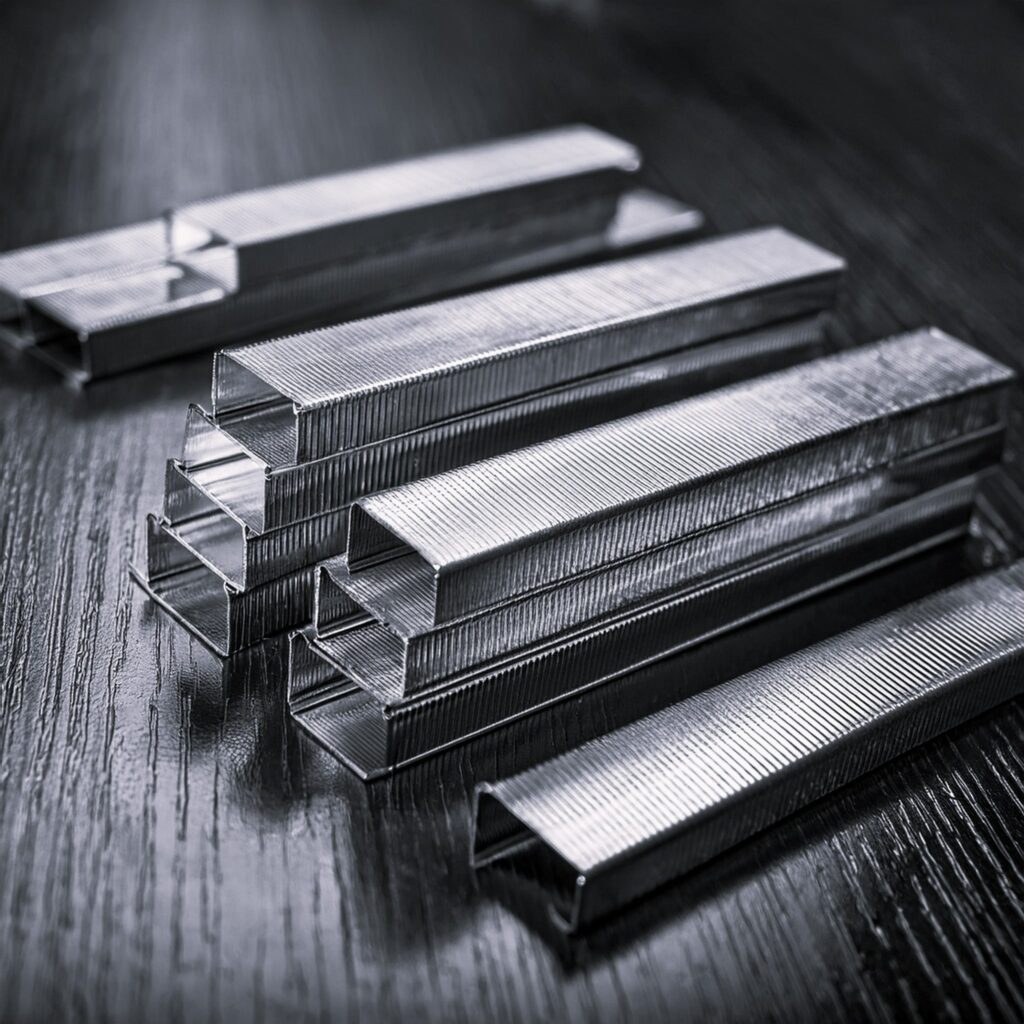
Every industrial staple pin has three defining physical characteristics: the crown, the legs, and the wire from which it is formed. The crown is the flat horizontal top section that sits on the surface of the material being fastened. The legs are the two vertical sections that penetrate the substrate. The wire gauge determines the diameter and therefore the tensile strength of the staple.
Crown width is a critical selection parameter. In standard corrugated box stitching, crown widths typically range from 20mm to 35mm. A wider crown distributes the fastening force over a larger surface area, which is advantageous when working with thick or multi-wall corrugated board. A narrower crown is better suited for thinner materials or applications where a minimal visual footprint is required, such as retail display packaging.
Leg length must be matched to the total thickness of the material layers being joined. The general engineering rule is that the leg should be long enough to allow a full clinch on the inside face — meaning the legs fold back flat against the inner surface rather than bending awkwardly or pulling through. For standard single-wall corrugated board (approximately 3.5–5mm thick), a leg length of 14–18mm is typically appropriate. For double-wall board or wooden packaging substrates, longer legs of 25–40mm may be required.
Wire gauge is measured on the Standard Wire Gauge (SWG) or American Wire Gauge (AWG) scale, and the packaging industry most commonly uses staple pins in the range of 16 to 23 gauge, depending on the application. Thicker wire (lower gauge number) provides greater shear and tensile strength but requires a more powerful stitching machine and leaves a larger hole in the packaging surface. Finer wire (higher gauge number) is gentler on packaging materials and suitable for lighter-duty applications but will not provide adequate holding strength in heavy corrugated or wooden packaging.
How Industrial Staple Pins Are Used in Packaging Operations
The packaging industry uses best industrial staple pins in a surprisingly wide range of contexts, but the dominant applications fall into three broad categories: corrugated carton sealing, wooden crate and pallet assembly, and multi-wall bag closure.
In corrugated carton sealing — by far the highest-volume application — industrial staple pins are fed in coil or strip form into automatic carton closing machines. These machines stitch the bottom and top flaps of Regular Slotted Containers (RSCs) as they travel along a conveyor system. High-speed lines in major e-commerce fulfillment centers and fast-moving consumer goods (FMCG) plants can stitch hundreds of cartons per hour. At this pace, the dimensional consistency and wire quality of the staple pin directly determines uptime.
In wooden crate and pallet assembly, heavier-gauge staple pins are driven pneumatically into timber to join boards, panels, and structural members. The staple pins used in these applications are typically 16 to 18 gauge — heavy enough to grip hardwood and softwood reliably — and are often hot-dip galvanized to resist the moisture exposure common in storage yards and ocean freight containers.
Multi-wall paper bag closure is the third major application. Bags used in the cement, fertilizer, flour, and chemical industries are sealed by clinching staples that fold back against the inside wall of the bag. This type of closure must hold reliably under the weight of 25 to 50 kilograms of product, through vibration during transit, and in humid or outdoor storage conditions.
The True Cost of Using the Wrong Industrial Staple Pin
One of the most important — and most commonly ignored — points about selecting the best industrial staple pins is that the purchase price of the staple pin is rarely the most significant cost. The real cost is in what happens downstream when you use a poor-quality or incorrectly specified product.
Machine downtime is the most immediate consequence. A staple pin with inconsistent dimensions — crown width slightly out of tolerance, legs not perfectly parallel, wire gauge varying between batches — is a primary cause of stitching machine jams. Each jam on a carton closing line requires an operator to stop the line, clear the jam, and restart the machine. In a high-volume operation, multiple jams per shift can add up to dozens of minutes of lost production time every day.
Package failures create a second category of cost. When an industrial staple pin lacks the required holding strength — because it was made from low-grade wire, has an insufficient leg length for the material thickness, or was formed with poorly clinched legs — the packaging fails in transit. Corrugated cartons burst open. Wooden crate panels separate. Multi-wall bags split at the seam. The downstream cost of product damage, customer claims, and returns typically dwarfs the cost of the staple pins themselves.
Corrosion and contamination create a third cost dimension that is particularly acute in food, pharmaceutical, and export packaging. A galvanized staple pin with inadequate zinc coating will begin to rust within days in a humid environment. In a food packaging context, rust particles represent a serious contamination hazard and a potential regulatory violation. In export packaging, corroded staple joints weaken the structural integrity of wooden crates during the weeks-long journey by ocean freight.
Understanding these cost dimensions reframes the procurement conversation entirely. The question is never simply “which supplier offers the cheapest price per kilogram?” The question is “which supplier offers the best industrial staple pins for my specific application at the lowest total cost of ownership?” These are very different questions, and the answers often lead to very different purchasing decisions.
The Global Market Context
The global market for industrial staple pins is a substantial and growing segment of the broader packaging consumables industry. Key manufacturing countries include China, India, Germany, the United States, and Taiwan. India in particular has emerged as a significant and increasingly competitive source for high-quality industrial staple pins across all major packaging applications, with several manufacturers having achieved international quality certifications and built strong export track records.
Demand for industrial staple pins is closely correlated with the health of the e-commerce, FMCG, agriculture, and industrial manufacturing sectors. The explosive growth of e-commerce since 2020 has driven particularly strong demand for corrugated box stitching wire, as online retailers and their fulfillment partners process unprecedented volumes of outbound shipments. Simultaneously, the push for more sustainable packaging — with corrugated and paper-based materials displacing plastic alternatives — is expanding the addressable market for industrial staple pins further.
For procurement professionals, this market context matters because it informs sourcing strategy. Suppliers who are investing in quality and capacity to serve high-growth e-commerce customers are likely to be more reliable partners than those focused purely on low-cost commodity production. When you are sourcing the best industrial staple pins for a packaging operation where uptime and consistency are non-negotiable, supply chain reliability is as important as product specifications.
Materials, Specifications, and Machine Compatibility: The Technical Guide
Choosing the Right Material for Your Environment
Material selection is the single most consequential technical decision you will make when specifying industrial staple pins for your packaging operation. The material determines corrosion resistance, tensile strength, food safety compliance, and long-term performance — and it is the dimension where cutting costs most frequently creates the biggest problems downstream.
Galvanized Steel — The Packaging Industry Standard
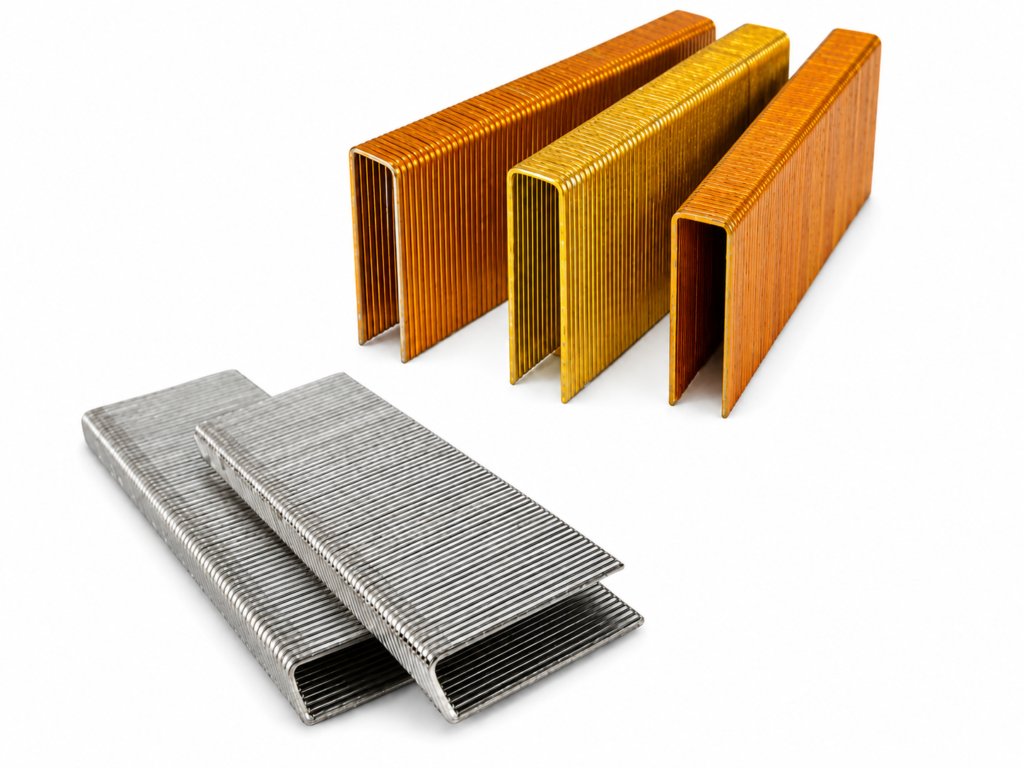
The majority of industrial staple pins used in the packaging industry are made from galvanized steel — steel wire with a protective zinc coating applied either by electro-galvanizing or hot-dip galvanizing. Galvanized steel offers an excellent combination of mechanical strength, corrosion resistance, and cost, making it the default choice for most corrugated carton sealing, wooden crate assembly, and agricultural packaging applications.
Electro-galvanized staple pins have a thin, uniform zinc coating applied by electrochemical deposition. The result is a bright, smooth surface finish that feeds consistently through automated stitching heads and resists light oxidation during indoor storage. Electro-galvanized staples are the standard specification for high-speed carton closing lines where feed consistency is paramount.
Hot-dip galvanized staple pins are coated by immersion in molten zinc, producing a thicker, slightly rougher coating. The additional zinc mass — typically 275 to 350 grams per square meter compared to 30 to 80 g/m² for electro-galvanized — provides substantially greater corrosion resistance. Hot-dip galvanized staple pins are the preferred specification for wooden crate assembly, agricultural packaging, and any outdoor or high-humidity storage environment.
When evaluating suppliers of best industrial staple pins in galvanized steel, always request the zinc coating weight specification. A supplier quoting a galvanized product without specifying coating weight may be supplying a lightly electro-galvanized pin when your application requires hot-dip quality. This distinction can mean the difference between a joint that holds for three years and one that is rusting within three months.
Wire Gauge Selection: Getting the Strength Right
Selecting the correct wire gauge is fundamental to achieving the right balance of holding strength, material penetration, and machine compatibility. The packaging industry uses a range from 16 gauge (heavy duty) to 23 gauge (fine wire), and each segment of this range is suited to specific applications.
At the heavy end of the range, 16 and 17 gauge staple pins are specified for wooden packaging — crates, packing cases, and heavy timber pallet assembly. These gauges require powerful pneumatic or hydraulic stitching tools and leave a relatively large penetration hole, but they provide the shear and tensile strength needed to hold structural timber joints under the stresses of international freight. When sourcing the best industrial staple pins for wooden export packaging, 16 to 18 gauge hot-dip galvanized wire is almost always the correct specification.
In the mid-range, 19 and 20 gauge staple pins are the workhorses of corrugated carton sealing. This is the gauge range used by the vast majority of automatic and semi-automatic carton closing machines in the packaging industry. At this gauge, the wire is strong enough to provide a secure flap closure on single-wall and double-wall corrugated board, while fine enough to be fed reliably through high-speed stitching heads without excessive machine wear.
At the finer end, 21 to 23 gauge staple pins are used for light packaging applications — thin corrugated display boxes, retail cartons, point-of-sale packaging, and multi-wall paper bags. Fine wire staples minimize the visible footprint on printed packaging surfaces and are less likely to cause material tear on thinner substrates.
Crown and Leg Dimensions: The Specification Details That Matter
Beyond gauge, the crown width and leg length of an industrial staple pin must be carefully matched to both the packaging material and the stitching machine being used. Crown width in packaging applications typically ranges from 20mm for fine-wire display packaging work up to 38mm for heavy corrugated applications. For standard RSC carton sealing on single-wall board, a crown width of 25 to 32mm combined with a leg length of 14 to 18mm is the most common specification.
An important practical note: the leg length specification you choose must account for the total compressed thickness of all material layers being joined, including any liner overlap at the seam. A leg that is too short will not clinch properly and will result in a weak joint. A leg that is too long will over-penetrate the material and may cause the legs to fold back in an irregular pattern, which can both weaken the joint and create a hazard if sharp leg ends protrude into the interior of the package.
Machine Compatibility: The Specification Constraint That Cannot Be Ignored
Even the best industrial staple pins in the world will cause constant problems if they are not compatible with your stitching equipment. Machine compatibility is a non-negotiable specification constraint that must be established before any other selection criteria are evaluated.
Every carton closing machine, stitching head, and pneumatic staple gun has a defined range of compatible staple pin specifications — typically covering wire gauge range, crown width tolerance, leg length range, and wire form (flat coil, round coil, or preformed strip). Operating outside this specified range will result in feed failures, misfires, and potentially serious damage to the stitching head.
Major carton closing machine manufacturers such as Mosca, Signode, Intertape Polymer Group, and Schneidereit publish detailed compatibility specifications for their equipment. Before specifying an industrial staple pin for a new application or switching suppliers, always cross-reference the staple pin dimensions against the machine manufacturer’s published tolerance ranges. If you are working with legacy or imported equipment for which documentation is unavailable, request a pre-production machine trial from your staple pin supplier before placing a volume order.
The wire form of the staple pin is also a compatibility factor that is easy to overlook. Some machines accept loose-coil wire and form the staple on-the-fly within the stitching head. Others require factory-formed strips or pre-joined collated staples. Using the wrong wire form — even if the gauge and dimensions are correct — will prevent the machine from feeding correctly and may require a complete changeover of the feed mechanism.
Quality Standards and What to Look for in a Supplier Certificate
When sourcing best industrial staple pins at volume, quality documentation is not optional. At a minimum, any serious supplier should be able to provide an ISO 9001 certificate confirming that they operate a documented quality management system, dimensional inspection reports confirming that each production batch meets the stated tolerance specifications, and — for stainless steel products — a Material Test Certificate (MTC) confirming the alloy grade and chemical composition.
For food and pharmaceutical packaging applications, additional certifications may be required. These can include RoHS compliance documentation, certificates of conformity to EU or US food contact material regulations, and evidence of HACCP or ISO 22000 implementation at the manufacturing facility. If your packaging operation is audited by a major retailer or food service customer, your staple pin supplier’s documentation will likely be reviewed as part of the supply chain assessment.
Dimensional tolerance specifications are another key quality indicator that separates premium suppliers from commodity producers. The best industrial staple pin manufacturers publish tolerance specifications of plus or minus 0.05mm on wire gauge and crown width, and maintain these tolerances consistently across batches. Suppliers who cannot or will not provide tolerance data are almost certainly producing to wider variances — and those variances will show up as machine jams and inconsistent seals on your production line.